An 18th-century residence, with 16th-century outbuildings and a formal garden, in the Loire Valley, near Chinon - ref 748486
An 18th-century residence, with 16th-century outbuildings and a formal garden, in the Loire Valley, near Chinon.
This property is located in the Loire-Anjou-Touraine natural regional park, in the western part of the Indre-et-Loire area, in a historical village famous for being a regular hunting ground for Louis XI. In addition to the many watermills, washhouses, mansions and manors that the municipality boasts, there are also convenience shops, a weekly market and a 12th-century church, all of which can be reached on foot. The music school and the house of Max Ernst, where the artist and his wife settled in the 1950s, hold conferences, exhibitions and cultural events throughout the year. The town of Chinon is 12 minutes away by car, while Tours and Angers are respectively 45 minutes and 1 hour away. Paris can be reached in 2 hours 15 minutes by train and 3 hours 10 minutes by road.
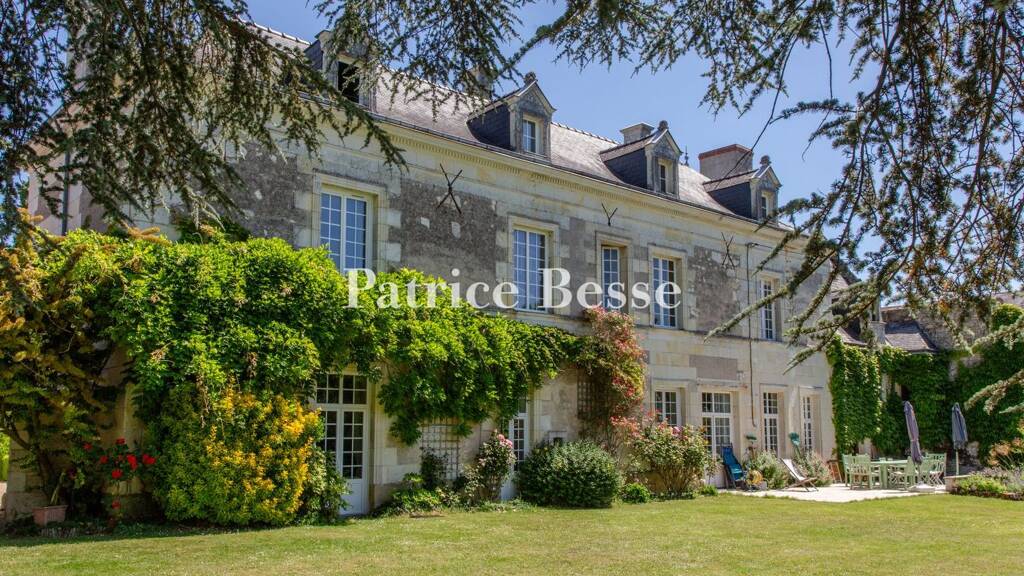
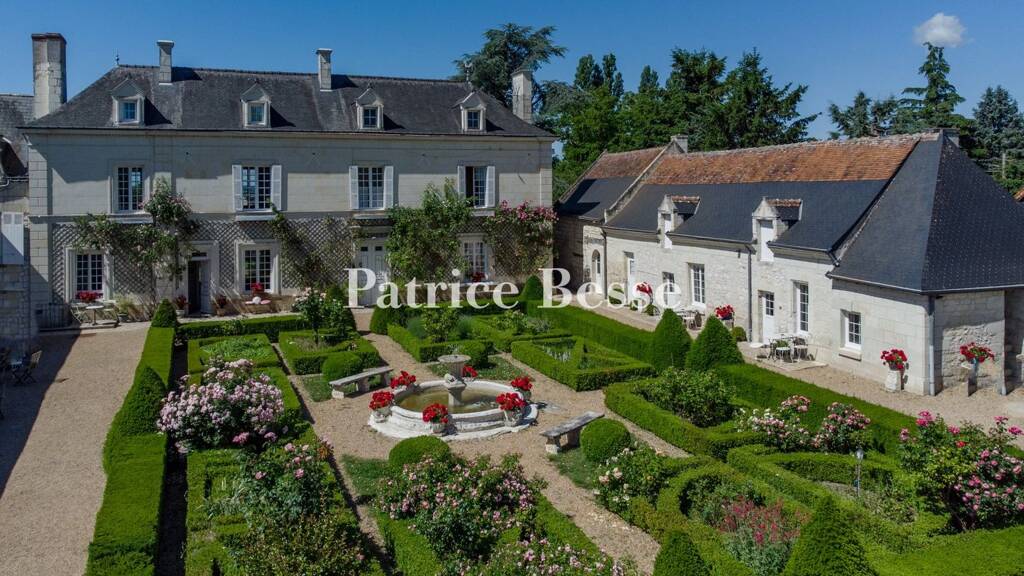
At the corner of two small streets in the village centre, an ironwork gate framed by two embossed pillars opens into the main courtyard. The property was completed at the end of the 15th century and was destined at the time for collection of land tax for the king. In the middle of the 16th century, it was acquired by the Dreux family who owned it until the French Revolution. Its occupants were in turn an officer of the waterways and forests of Chinon, prosecutor for the bailiwick of the same town and a king's adviser. It was partially burned in 1789, after which the main building was restored in the Directory era style. The three-storey building has a hipped roof dotted with four gable dormers with triangular pediments.
The tuffeau stone façade is topped by a modillon cornice. The many 18th-century bay windows enable light to stream into both sides of the house. The 16th-century outbuildings, found on either side of the house, are also made of tuffeau stone, combining façades of dressed stone and rubble stone. The roofs are made of slate and one of the buildings is topped by a hipped roof with slightly drawn back eaves. In addition to bedrooms and living rooms, the outbuildings contain two plum ovens that are closely linked to the municipality's history, a bread oven, an orangery and a functioning well. In front of the house, the symmetry of the formal garden provides rhythm to the main courtyard. To the rear, there is a landscaped garden and a swimming pool. At a depth of 12 metres, there is a cellar with many tuffeau stone vaults, the use of which can still be read on the stone. The property stands in a fully enclosed plot of 4,521 m².
The main house
The ground floor
A vast entrance hall leads to reception rooms on either side. The dining room is bathed in light, with a tiled floor as well as wood panelled walls, and boasts a fireplace with a black marble mantelpiece topped by a sculpted trumeau mirror painted with floral patterns. This is followed by a lounge with period oakwood flooring. Wainscotting and a wall tapestry frame two bookshelves between which there is a marble fireplace. The patio can be reached through French windows. Facing northeast and southeast, these two dual aspect rooms respectively have surfaces of 32 m² and 40 m². A kitchen next to the dining room opens directly onto a patio at the rear of the house. In the entrance hall, a single-flight quarter-turn staircase flooded with light thanks to a window on the façade climbs up to the upper floors.
The first floor
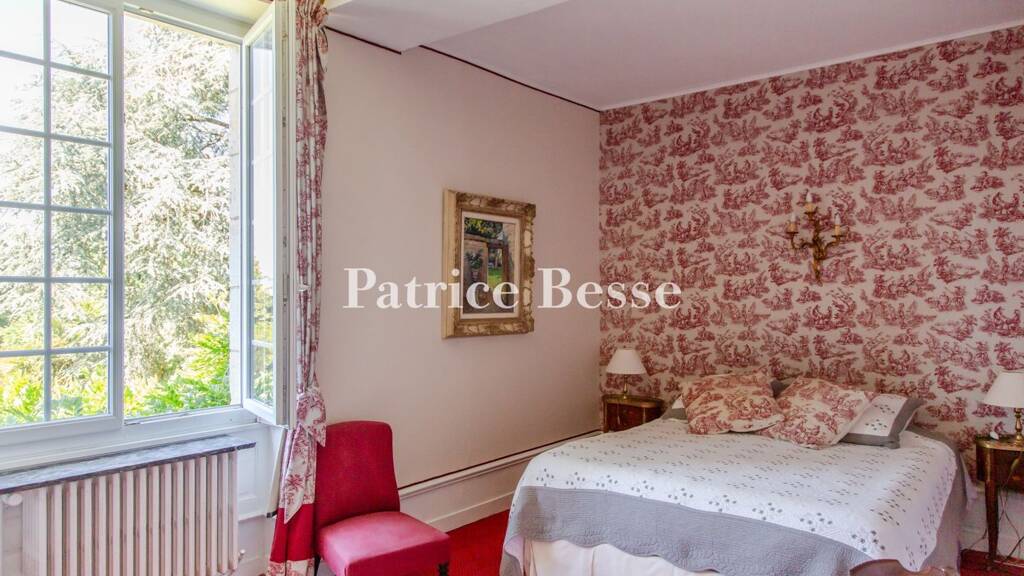
On one side, the landing leads to two bedrooms, one of which is decorated with toile, has an en suite shower room and boasts views over the grounds. Opposite, a bathroom stands alongside a walk-in wardrobe. On the other side, there is another walk-in wardrobe, a bedroom, with an en suite shower room, and an office next to it.
The attic
This level was a loft which has been converted into two bedrooms, a shower room and a ...